

The immune system is a complex network of cells, tissues, organs and proteins that work together to keep the body healthy. The immune system’s primary roles are to recognize something foreign and destroy it, differentiate self from nonself, keep self healthy and destroy malignancies. Because of the many intricacies within the immune system, if something is deficient or defective, the result can be an immune deficiency or autoimmune condition.
The Immune System’s Lines of Defense
The immune system has two main lines of defense: innate immunity and adaptive immunity.
Innate immunity is what people are born with. The innate immune system is the first to respond to an antigen (foreign substance), and its response is immediate — within minutes or hours. It is made up of several parts that form a physical barrier to protect the body. Components of innate immunity include the skin and any other mucus membranes that protect organs such as the cornea of the eye and the lining of the lungs and intestine. The skin provides a barrier, as well as an acidic environment to repel growth of bacteria and other microbes. Mucus membranes also contain normal flora, which is where microbes reside without causing illness, and the mucus can trap any foreign invaders. There are also various cells that specialize in ingesting microbes and destroying them, including blood monocytes, neutrophils and macrophages, which are all types of white blood cells. In addition, other cells contribute to symptoms such as inflammation and fever that occur when there is a foreign invader that needs to be destroyed. However, innate immunity has no memory.
The Immune System’s Protective Defenses
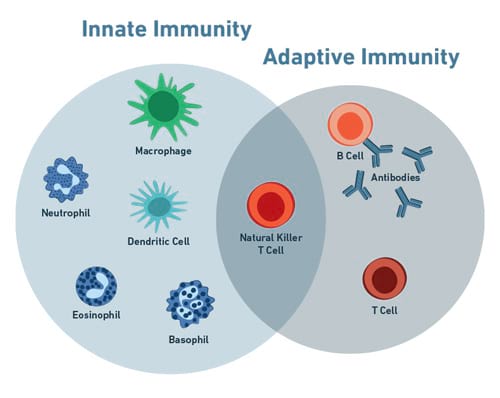
Accessed at blog.cellsignal.com/immunology-overview-how-does-our-immune-system-protect-us.
Adaptive immunity works synergistically with innate immunity, taking over when the innate immune response isn’t adequate to destroy an antigen. The primary functions of the adaptive immune response are the recognition of specific “nonself ” antigens; the generation of pathogen- specific immunologic effector pathways that eliminate pathogens or pathogen- infected cells; and the development of an immunologic memory to quickly eliminate the pathogen should subsequent infections occur.1 In other words, adaptive immunity generates an immune response that destroys the antigens that should not be there and keeps the ones that should be in the body intact, all the while developing a memory of that immune response if a similar infection occurs.
The Innate vs. Adaptive Immune Response
| Type of Immunity | Line of Defense | Timeline | Cells | Antigen | Stabilizer |
|---|---|---|---|---|---|
| Innate (nonspecific) | First | Immediate response (0 to 96 hours) | Natural killer cells, macrophages, neutrophils, dendritic cells, mast cells, basophils, eosinophils | Independent | Skin, hair, cough, mucous membranes, phagocytes, granulocytes |
| Adaptive (specific) | Second | Long term (more than 96 hours) | T and B lymphocytes | Dependent | Pus, swelling, redness, pain, T and B lymphocyte response |
The main cells of adaptive immunity are T cells and B cells. T cells originate from stem cells in bone marrow and mature in the thymus. Although the thymus is part of the immune system, it is possible to survive without one, which is also true for the spleen and the appendix. Once T and B cells mature, they can differentiate into either cytotoxic T cells, which will destroy cells infected by an antigen, or helper T cells, which help to mediate an immune response by activating other immune response cells (for example, a B cell).
B cells originate and mature in the bone marrow. On the surface of B cells are immunoglobulins (Igs), also known as proteins or antibodies, that are an integral part of the immune response, particularly antibody-mediated immunity. There are five types of Igs: IgG and its subclasses IgA, IgM, IgE and IgD, each of which serve distinct functions. Igs play an important role in containing virus proliferation (replication inside infected cells and transmission to new target cells) during the acute phase of infection. B cells are also responsible for memory so they can respond to any future infections with the same pathogen.
Adaptive immunity can be further broken down into antibody-mediated and cell-mediated immunity. Antibody- mediated immunity is the part of the acquired immune system (innate immunity) that is mediated by B-cell-antibody production. The antibody-production pathway begins when secreted antibodies bind to antigens on the surface of pathogens, flagging them for destruction.2 However, antibodies are not generally capable of eliminating a virus once infection has occurred. Instead, once an infection is established, cell-mediated immune mechanisms are most important in protecting the body against most intracellular pathogens. Cell- mediated immunity does not involve antibodies, but rather protects an organism with mature T cells, macrophages and the release of cytokines in response to an antigen.2
The Immune System

Accessed at oncologypro.esmo.org/education-library/essentials-for-clinicians/chapter-1-the-immune-system.
Boosting and Weakening the Immune System
There are several ways the immune system can be boosted (helped) or weakened. Avoiding things that are unhealthy and developing healthy habits are the best ways to keep the immune system healthy. The Centers for Disease Control and Prevention (CDC) lists six tips to enhance immunity, including eating well, staying physically active, maintaining a healthy weight, getting enough sleep, avoiding smoking and avoiding too much alcohol. CDC also recommends taking appropriate vaccines to build immunity against specific diseases.3
What weakens the immune system is essentially the opposite of these tips: poor nutrition, which includes too much sugar and not enough fiber; not getting enough exercise; not getting enough sleep, which can be impacted by too much caffeine late in the day; and drinking too much alcohol. Additionally, there is evidence that a high-stress lifestyle and loneliness can weaken the immune system.4
Keeping the Immune System Functioning
In summary, numerous components that serve different functions are involved in the immune system and the immune response. Although genetics and other factors are things people cannot control, it is crucial to engage in healthy habits to ensure the immune system functions at its best.
References
- Bonilla, FA, and Oettgen, HC. Adaptive Immunity. Journal of Allergy and Clinical Immunology, 2010;125(Suppl 2):S33–40. Accessed at pubmed.ncbi.nlm.nih.gov/20061006.
- Marshall, JS, Warrington, R, Watson, W, et al. An Introduction to Immunology and Immunopathology. Allergy, Asthma & Clinical Immunology, 14 (Suppl 2), 49 (2018). Accessed at aacijournal.biomedcentral.com/articles/10.1186/s13223-018-0278-1.
- Centers for Disease Control and Prevention. Healthy Habits: Enhancing Immunity. Accessed at www.cdc.gov/healthy-weight-growth/about/enhancing-immunity.html
- WebMD. Things That Suppress Your Immune System. Accessed at www.webmd.com/cold-and-flu/ss/slideshow-how-you-suppress-immune-system.